Call Us Mon-Fri from 7:30 am-6:30 pm or Saturday-Sunday: 9:00 am–2:00 pm 508-203-6966
Call Us Mon-Fri from 7:30 am-6:30 pm or Saturday-Sunday: 9:00 am–2:00 pm 508-203-6966

This page gives a high level breakdown of a solar construction project by Whaling City Solar in downtown New Bedford, Massachusetts. This 76-panel project was completed in the heart of New Bedford’s iconic downtown. Resting on historic Union Street above a mural of Frederick Douglass and blocks from New Bedford Whaling National Historic Park, this installation speaks to our name—Whaling City Solar—and our commitment to continuing New Bedford’s legacy as a city of light. Putting our tiny fingerprint on this historic waterfront is a moment of pride for our company.
One of the reasons we use this module line from this manufacturer, is that its safe to design and price. The unit is the most popular family of solar panels in the United States, and is often available fresh from the company’s manufacturing facility in Georgia. Recently, the module has evolved from the 485 Watt class to a 560 Watt class, and now an even larger 620 watt class.
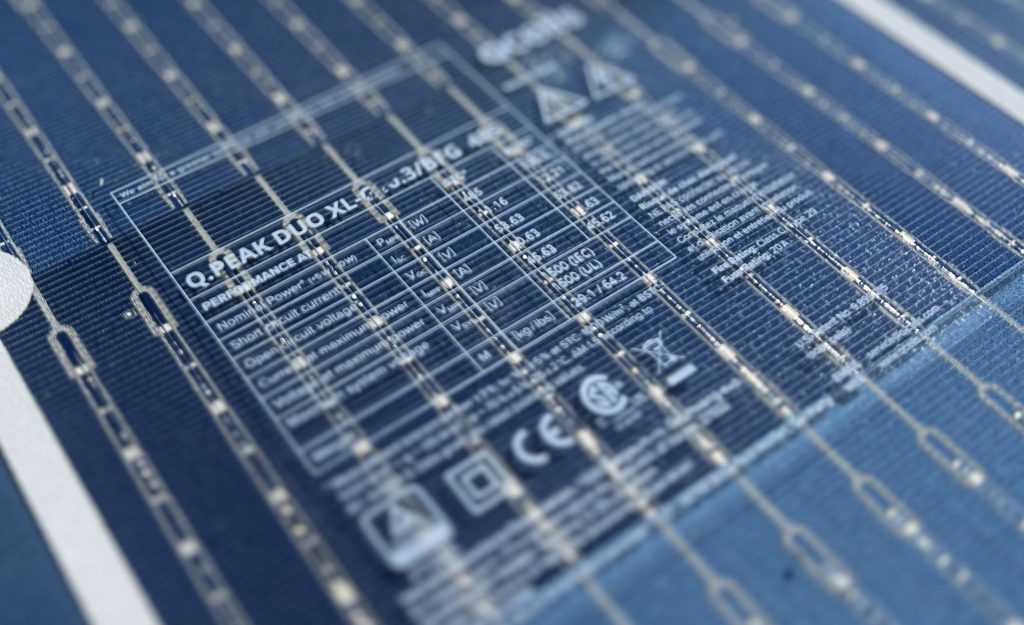
The Q Cells Q.PEAK DUO XL-G10.3 485W solar panel is designed broad applications and long durability. From the spec sheets, it has an energy conversion rate of over 20.9%, it makes the most of every ray of sunlight, thanks to its Q.ANTUM DUO-Z technology and zero-gap cell layout. This means there is no wasted space between solar cells.
Essentially, the whole solar panel facing the sun can make electricity.
Built to last, this panel features a double-glass design and a high-strength aluminum alloy frame, making it resistant to heavy snow, strong winds, and long-term wear.
With a 12-year product warranty and a 30-year performance guarantee, coupled with a healthy global company backing it, we feel the Q.PEAK DUO XL-G10.3 485W is a smart, long-term investment for anyone looking to maximize solar energy production.
The EcoFoot2+ is a high-efficiency ballasted solar racking system designed for rapid and secure installation on flat rooftops. With just three main components—base, universal clamp, and wind deflector—this system simplifies logistics. It speeds up deployment, allowing installers to mount up to 13.5 panels per hour with minimal effort. The pre-assembled universal clamp fits 30-50mm module frames, making it adaptable to a variety of panel sizes without additional components.
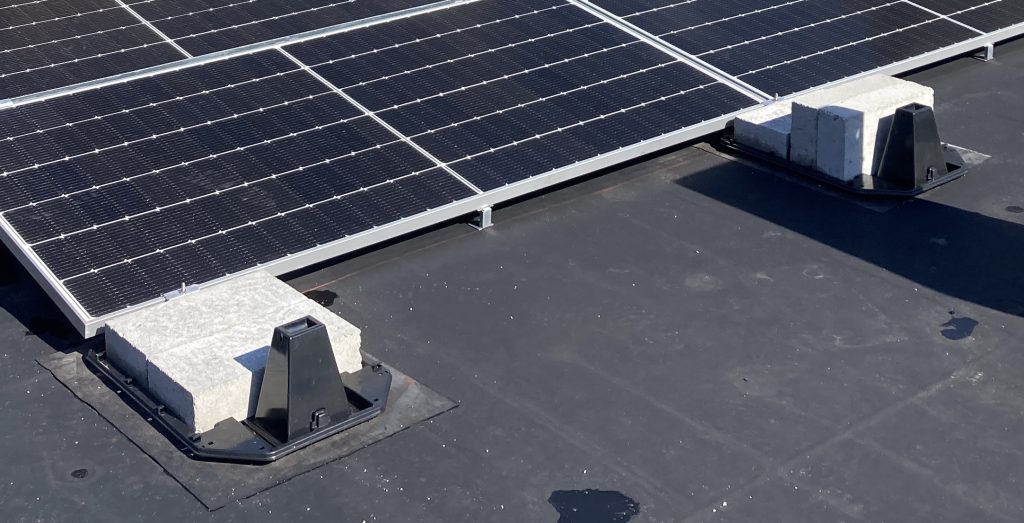
For smaller rooftops, in windier and saltier coastal regions – like New Bedford – the racking system comes with corrosion-resistant wind deflectors, which help minimize uplift and reduce ballast (the white bricks above) requirements. Having ballast allows us not to penetrate the rooftop. However, too much ballast is heavy – so we can only do so much. The hardware UL2703-certified, wind tunnel tested, and SEAOC seismic compliant, ensuring accurate design in high-wind areas like the setting of Moby Dick. We also like the low part count, simple chalk-line layout, for commercial solar projects as we do our best to be cost efficient with our labor costs.

The Yaskawa Solectria PVI-25TL-208 inverter is a powerful and reliable 25kW, transformerless three-phase string inverter designed for commercial and industrial solar installations. The company was originally founded out of a MIT startup that made electric cars. Rooftop solar industry standard is now a 1000V DC input. The building’s electrical service was 208V AC.
It features three independent Maximum Power Point Trackers (MPPTs) with two inputs each. MPPT lets each string of panels operate at its own ideal voltage/current “sweet spot” so that panels facing different directions or experiencing shade can still produce their maximum power without dragging down the rest of the array.
The greatest challenge that this solar power project came in securing approvals from various organizations. The historical district cared significantly that the solar power project wouldn’t affect the visual aspects of the downtown area. With the proper documentation as worked through it. As well, the City of New Bedford was very adamant in how the safety regulations were followed. We had several very spirited conversations with the building inspectors!
In total, the installation time for the solar racking was about four days, with the solar modules taking two days. We wired the solar modules and installed the inverters in about three days. We then connected the rooftop system to the electrical room – a complex undertaking in an older structure – in about three days. Lastly, we installed a street level disconnect for the fire department in about two days.

These days, the solar power system is outputting electricity every sunny – and even cloudy – day!
Interested in going solar in New Bedford? Contact us or call 508-203-6966 for a free consultation today!